Apostolic Strategy: How the Apostles Ordered the Mission

Series Introduction: The Apostolic Pattern
The risen Jesus did more than send the apostles into the world. He called them to himself, formed them through his teaching and example, shaped their character through obedience and suffering, entrusted them with his message, and governed the early church through their witness. Through the apostles, Jesus revealed the pattern by which his mission advances: the gospel proclaimed, communities gathered, disciples formed, leaders developed, and churches multiplied among the nations.
The New Testament does not merely preserve the apostles’ activity as history. It gives the church the authoritative apostolic witness by which the risen Christ continues to lead, correct, and strengthen his people after his ascension, by the Spirit through the Word. Acts and the apostolic letters show how the Lord ordered message, practices, relationships, and priorities under this authority. Yet this apostolic pattern is often overlooked, fragmented, or replaced by contemporary models that emphasize isolated strengths—whether growth, relevance, innovation, structure, or even doctrine—without the integrated framework that holds these together under Christ’s reign.
This series exists to recover that coherence. The fourteen documents in The Apostolic Pattern examine distinct dimensions of the pattern Christ revealed through the apostles, and together they present a unified, Scripture-rooted vision for ministry under the reign of Jesus. What follows is not a new model or movement, but careful attention to what Christ has already given his church, so that believers and leaders may align their lives, churches, and networks with the same Lord, the same gospel, and the same mission that shaped the first-generation church and continues until he returns.
THE FOUNDATIONS OF THE APOSTLES’ MINISTRY (1–3)
1. Apostolic Mission
2. Apostolic Calling and Conversion
3. Apostolic Virtues
THE APPROACH OF THE APOSTLES’ MINISTRY (4–5)
4. Apostolic Principles
5. Apostolic Strategy
THE EXPRESSIONS OF THE APOSTLES’ MINISTRY (6–13)
6. Apostolic Implementation
7. Apostolic Message
8. Apostolic Doctrine
9. Apostolic Gatherings
10. Apostolic Unity
11. Apostolic Education
12. Apostolic Endurance
13. Apostolic Hand Off
THE VISION OF THE APOSTLES’ MINISTRY (14)
14. Apostolic Vision and Legacy
Together, these documents provide a coherent framework for understanding and practicing ministry under the reign of the risen Christ.
Document Summary: Apostolic Strategy
Purpose: This document clarifies how the apostles ordered the mission of Jesus, so churches and church networks can plan, evaluate, and act with apostolic clarity, balance, and endurance.
Central Claim: The risen and reigning Jesus revealed a coherent strategy through the apostles for advancing the gospel, strengthening churches, and developing leaders, and that apostolic pattern must govern church strategy in every generation.
Why This Matters: When churches build strategy mainly from culture, tradition, or personality, ministry becomes imbalanced. Some emphasize reaching unbelievers but neglect strengthening disciples in community. Others strengthen believers but fail to form leaders and multiply churches. The New Testament shows the apostles holding these priorities together in an integrated pattern. Recovering that pattern protects churches from fragmentation and gives leaders biblical categories for planning and evaluation.
What This Document Does:
Defines apostolic strategy as the ordered pattern of ministry visible in Acts and the Epistles
Clarifies the core commitments that shaped the culture of apostolic work
Presents the three mission-ordering goals that governed apostolic ministry
Identifies the simple, repeatable activities that expressed those goals across contexts
Explains how churches can adapt methods while remaining faithful to apostolic guardrails
What This Document Is Not: This document is not a claim that one modern program is “the” apostolic method, nor a corporate planning manual. It does not require identical forms in every culture, and it does not measure faithfulness by novelty, scale, or efficiency. It describes a Scripture-shaped pattern so churches can evaluate strategy by apostolic priorities rather than contemporary instincts.
Primary Outcome: Readers gain a clear framework for ordering church life and mission around apostolic priorities, enabling churches and networks to plan and evaluate ministry with shared biblical clarity.
Document Introduction: How the Apostles Ordered the Mission
The Central Question: How did the apostles order the mission Jesus entrusted to them so that the gospel advanced, believers were strengthened, leaders were formed, and the work endured across places and generations? Churches today often possess many good activities but lack a shared way of ordering them. Evangelism, discipleship, leadership development, worship, and community life can drift into parallel tracks rather than forming a coherent whole. Strategy addresses this ordering question. Without a biblical strategy, churches measure faithfulness by activity, energy, or results rather than by alignment with the pattern Christ revealed through his apostles.
The Biblical Answer: The New Testament presents a consistent apostolic strategy. The apostles worked from shared commitments shaped by devotion to the triune God, Scripture, prayer, holiness, and fellowship (Acts 2:42–47). Within that framework, they held together three integrated goals: reaching unbelievers with the gospel, strengthening believers in community, and developing leaders to shepherd and multiply churches (Acts 14:21–23; Col. 1:28–29; 2 Tim. 2:2). They pursued these goals through simple, repeatable activities that appeared wherever the mission advanced, adapting methods to context while guarding the gospel and the pattern itself (Acts 17:22–31; 1 Cor. 9:19–23; Gal. 1:6–9).
How This Document Fits in the Series: This document follows Apostolic Principles because commitments must be embodied in an ordered pattern of action if the mission is to remain faithful over time. Principles describe what governed apostolic life. Strategy shows how those commitments shaped the apostles’ priorities, movement, and decisions as the mission advanced. This document provides the strategic framework that underlies the more specific apostolic practices addressed in the documents that follow.
Purpose and Approach: The purpose of this document is to describe the apostolic strategy Scripture displays and to give churches a shared framework for planning and evaluation. It will clarify how the apostles ordered ministry around enduring commitments, integrated goals, and repeatable activities. The aim is not to impose uniform methods, but to help churches resist drift and remain aligned with the way Jesus ordered his mission through the apostles.
The Detailed Model
Below we outline and explain the 10 core commitments and the three main goals—each with five activities.
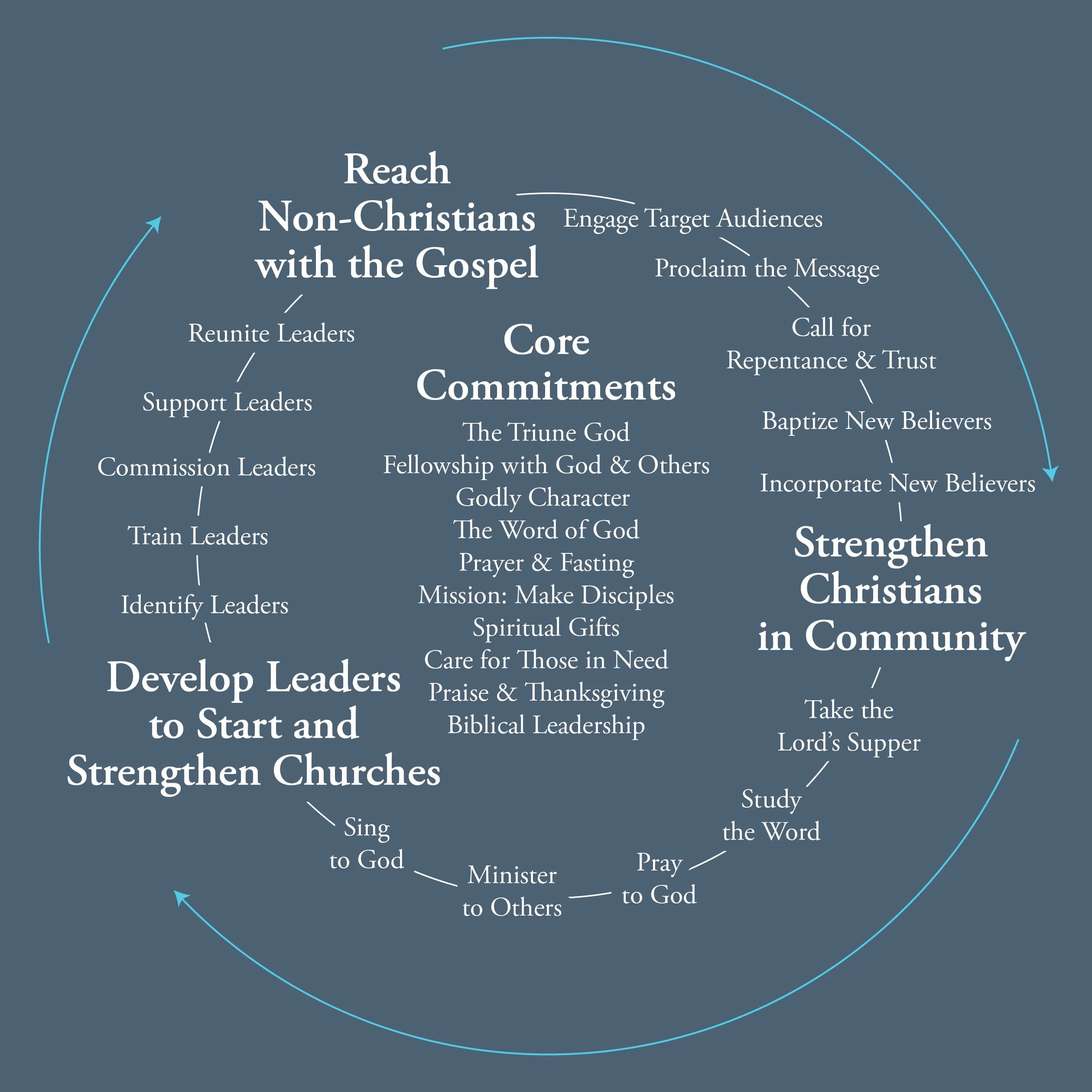
Core Commitments
Ten core commitments undergirded and saturated every part of the Apostolic Cycle. Ultimately, Christians are committed to the triune God of the Bible—Father, Son, and Holy Spirit—and they seek to honor each person of the Trinity as outlined in Scripture (Matt 28:18–20; John 14–17; Eph 1:3–14). In light of God’s supreme worth and authority, Christians commit themselves to fellowship with God and others (1 John 1:3–7), godly character (Gal 5:22–23), the Word of God (Acts 2:42; Col 3:16), prayer and fasting (Acts 1:14; 13:1–3), the mission of Jesus Christ (Matt 28:19–20), using spiritual gifts to strengthen the church (Rom 12:3–8; 1 Cor 12–14), care for those in need (Acts 4:32–35; Gal 6:10), praise and thanksgiving (Eph 5:19–20), and biblical leadership (Acts 14:23; 1 Tim 3:1–13; Rom 16:1–2).
These commitments were not isolated from each other. Fellowship deepened godly character. The Word shaped worship. Prayer fueled mission. Spiritual gifts strengthened the community. When the apostles taught, corrected, planned, traveled, evangelized, or appointed leaders, these commitments formed the atmosphere of their work. They created a shared culture—a way of life under the lordship of Jesus and the power of the Spirit—that made the apostolic strategy durable, reproducible, and fruitful across vastly different settings.
These ten commitments formed the spiritual soil of apostolic ministry. Without them, none of the goals or activities could flourish. With them, the apostles built communities capable of sustaining holiness, mission, and multiplication in every place.
Goal 1: Reach Non-Christians with the Gospel
Jesus authorized his apostles to proclaim repentance and forgiveness of sins to all nations (Luke 24:46–49), promising the Spirit’s power for witness to the ends of the earth (Acts 1:8). Everywhere they went, the apostles initiated gospel advance by engaging people far from God, announcing Jesus’s saving work, calling people to repent and believe, baptizing those who responded, and incorporating them into communities that embodied the reign of Christ. This was not a program but a Spirit-empowered rhythm rooted in the authority and presence of Jesus.
Activity 1: The apostles engaged target audiences. The apostles entered synagogues (Acts 13:14–16; 14:1), marketplaces (Acts 17:17), lecture halls (Acts 19:9–10), and households (Acts 10:1–48), meeting people where they already gathered. They reasoned with Jews from the Scriptures (Acts 17:2–3) and dialogued with Gentiles about creation, judgment, and resurrection (Acts 17:22–31). This engagement was intentional and adaptive. Paul became “all things to all people” to win some (1 Cor 9:19–23), adjusting language, tone, and starting points without compromising truth.
This activity reveals a central strategic insight: gospel mission begins with movement toward people, not waiting for people to move toward the church. The apostles crossed cultural, religious, and social boundaries because they believed Jesus’s authority extended over every domain. Their example obligates churches today to discern where unbelievers gather, learn their questions and assumptions, and enter their spaces with humility, clarity, and confidence in the gospel’s power (Rom 1:16).
Activity 2: The apostles proclaimed the message. Their message centered on Jesus’s life, death, resurrection, and exaltation (Acts 2:22–36; 10:34–43; 13:26–41). They announced forgiveness of sins (Acts 10:43), the gift of the Spirit (Acts 2:38), and Jesus’s future return as judge and king (Acts 17:31). Apostolic proclamation was bold and reasoned, persuasive and doctrinally rich. It was always Christ-centered and cross-centered (1 Cor 1:18–25; 2:1–5).
This activity shows that mission cannot detach from proclamation. Social presence, mercy ministry, and relational investment matter deeply, but they do not replace speaking the gospel. Wherever churches minimize the cross, avoid the resurrection, or soften repentance, they depart from apostolic strategy and lose the only message that saves.
Activity 3: The apostles called people to repent and trust in Jesus. They summoned hearers to “repent and turn back” (Acts 3:19), to believe the gospel (Acts 16:31), and to acknowledge Jesus as Lord (Acts 2:36). Repentance was not optional; it was the necessary response to God’s saving work (Acts 17:30–31). Faith was personal trust in Christ crucified and risen, not generic spirituality or moral improvement.
This activity clarifies that conversion is not merely intellectual assent or cultural affiliation. It is a Spirit-wrought turning from sin to Jesus. Churches today must recover the courage to call for repentance and faith plainly, compassionately, and consistently.
Activity 4: The apostles baptized new believers. Those who responded were baptized into the name of the Father, Son, and Spirit (Acts 2:41; 8:12, 36–38; 16:33). Baptism marked a public break with the old life and union with Christ (Rom 6:3–5). It signaled entrance into the community of disciples under apostolic teaching.
This activity shows that baptism is not an optional ceremony. It is the God-given boundary between the world and the church, between unbelief and discipleship. Churches must treat baptism as the first act of obedience and the entry point into accountable community.
Activity 5: The apostles incorporated new believers into churches. They brought converts into the shared life of the community—fellowship, the apostles’ teaching, prayer, the Lord’s Supper, generosity, and mission (Acts 2:42–47; 20:20). New believers did not remain unattached. They were woven into households of faith that formed, strengthened, and governed them.
This activity emphasizes that evangelism aims at church formation, not at isolated decisions. The apostles expected new disciples to enter real communities where they could be taught, corrected, encouraged, and equipped. Modern mission drifts when it produces converts but not communities.
Reaching unbelievers was always the beginning, never the end, of apostolic mission. By engaging audiences, proclaiming Christ, calling for repentance and faith, baptizing new disciples, and incorporating them into churches, the apostles carried forward the mission Jesus entrusted to them. Churches today must begin where they began, trusting the same gospel and following the same pattern.
Goal 2: Strengthen Christians in Community
The apostles did not merely gather converts; they formed communities that embodied the teaching and character of Jesus. Strengthening believers meant grounding them in Scripture, prayer, worship, fellowship, holiness, and shared life. Though the churches carried out many activities themselves, these activities occurred under the apostles’ direction, instruction, and example, ensuring that the strengthening of believers aligned with Jesus’s commands and the Spirit’s work.
Activity 1: The apostles directed the churches to take the Lord’s Supper. Jesus commanded his disciples to remember his death through the bread and cup (Luke 22:19–20; 1 Cor 11:23–26). The apostles instructed the churches to celebrate this meal regularly, often in the context of shared fellowship meals (Acts 2:46). Paul corrected abuses in Corinth to ensure that the Supper proclaimed Christ’s death with integrity and unity (1 Cor 11:17–34).
The Lord’s Supper formed the church around Christ crucified. Under apostolic oversight, it renewed devotion to Jesus, called believers to examine themselves, and united them as one body (1 Cor 10:16–17). Churches today strengthen believers when they guard the Supper, celebrate it with joy and reverence, and use it to anchor the community in the cross.
Activity 2: The apostles taught the Word and directed churches to study it. The earliest believers devoted themselves to the apostles’ teaching (Acts 2:42). Paul commanded the public reading of Scripture (1 Tim 4:13), exhorted churches to meditate on the Word (Col 3:16), and wrote letters meant to be circulated and obeyed (Col 4:16; 2 Pet 3:15–16).
The Word created and sustained Christian maturity. Under apostolic leadership, Scripture shaped doctrine, ethics, worship, relationships, and mission. Today, Scripture must again govern the church’s imagination, decisions, and ministries.
Activity 3: The apostles directed the churches to pray. They modeled corporate prayer (Acts 1:14; 4:23–31), commanded persistent prayer (Eph 6:18; Col 4:2), and ordered prayer for leaders, the sick, and the mission (1 Tim 2:1–4; James 5:13–18). Prayer acknowledged dependence on God’s power and guidance.
Prayer strengthened churches by aligning them with God’s will, empowering witness, and sustaining endurance under persecution. Churches flourish when prayer saturates worship, decision-making, mission, and pastoral care.
Activity 4: The apostles instructed believers to minister to one another. They ordered care for widows (Acts 6:1–6), burden-bearing (Gal 6:1–2), hospitality (1 Pet 4:9–10), encouragement (Heb 10:24–25), and church discipline when needed (Matt 18:15–20; 1 Cor 5). Ministry was mutual, Spirit-empowered, and practical.
This ministry formed resilient communities marked by love, holiness, and shared responsibility. Under apostolic instruction, ordinary believers learned to meet physical needs, support the weak, and admonish the straying. Today’s churches must restore mutual ministry as a normal expression of life in Christ.
Activity 5: The apostles directed the churches to sing to God. They commanded believers to sing psalms, hymns, and spiritual songs (Eph 5:18–20; Col 3:16), using worship to teach, admonish, and build up the church. Singing expressed gratitude, reinforced doctrine, and strengthened unity.
This activity rooted believers in joy, hope, and endurance. Worship under apostolic direction placed Christ at the center of communal life and shaped the emotional and theological climate of the church. Churches today strengthen believers through worship that is biblically grounded, theologically rich, and Christ-exalting.
Strengthening believers required immersing them in a life of worship, teaching, prayer, mutual care, and fellowship—always under the apostles’ direction and in obedience to Jesus. These activities transformed converts into mature disciples capable of enduring persecution, resisting false teaching, and participating fully in the life of the church.
Goal 3: Develop Leaders to Start and Strengthen Churches
Leadership development was the hinge between strengthening believers and multiplying churches. The apostles consistently raised up elders, teachers, missionaries, and co-laborers who could share the work, guard doctrine, shepherd believers, and launch new initiatives. In every city, leadership development was the climax of their work (Acts 14:21–23).
Activity 1: The apostles identified leaders. They discerned men and women who demonstrated faithfulness, godly character, teachability, and a good reputation (Acts 6:3; 16:2; 1 Tim 3:1–13; Titus 1:5–9). They watched how people served, how they handled responsibility, and how others spoke of them.
Identification ensured that leadership was not based on giftedness alone but on character and proven faithfulness. Churches today must recover the apostolic practice of looking for dependable workers whom God has already begun to shape.
Activity 2: The apostles trained leaders. Training occurred through teaching (Acts 20:20–21, 27), modeling (Acts 20:18–19, 31–35), apprenticeship (2 Tim 3:10–11), Scripture formation (2 Tim 3:14–17), and direct ministry experience (Acts 13:5; 16:3–4). Leaders learned doctrine, ministry skills, suffering, prayer, and endurance.
This activity shows that training is relational, experiential, doctrinal, and long-term. Churches must establish pathways where emerging leaders watch, practice, learn, and grow under trusted mentors.
Activity 3: The apostles commissioned leaders. They laid hands on workers (Acts 13:1–3; 6:6), appointed elders in every church (Acts 14:23; Titus 1:5), and entrusted responsibility to proven servants (1 Tim 4:14; 2 Tim 1:6). Commissioning was public, communal, and prayerful.
Commissioning clarified calling, authorized ministry, and communicated trust. Churches today must restore the sacredness of commissioning and avoid casual or hasty appointments.
Activity 4: The apostles supported leaders. They supplied financial aid (Phil 4:15–16), sent encouragers (Acts 11:22–24), offered doctrinal guidance (1 Tim 1:3–5), and prayed for their endurance (2 Cor 1:11). Paul often revisited churches to strengthen leaders (Acts 15:36, 41; 18:23).
Support preserved leaders from discouragement, drift, and isolation. Churches today must build systems that uphold their leaders spiritually, emotionally, relationally, and materially.
Activity 5: The apostles reunited leaders. They gathered workers to report what God had done (Acts 14:26–28), to resolve doctrinal disputes (Acts 15:1–35), to debrief ministry challenges (Acts 20:17–38), and to plan next steps (Acts 18:22–23).
Reuniting created shared vision, doctrinal unity, and coordinated mission. Today’s churches must create regular rhythms where leaders reconnect, reflect, strengthen one another, and discern the Spirit’s direction together.
Leadership development enabled sustained mission, healthy churches, doctrinal stability, and multiplication. Without it, apostolic work would have collapsed under its own weight. With it, the mission expanded beyond any single worker or team.
Transferability Across Cultures
The apostolic pattern remains normative across cultures and times because Scripture presents it as continually practiced, repeatedly affirmed, and rooted in Christ’s commands and the Spirit’s work. The same commitments (Acts 2:42–47; Rom 12–15), the same goals (Acts 14:21–23), and the same activities appear across diverse contexts—Jerusalem, Judea, Samaria, Syria, Asia Minor, Macedonia, Achaia, and Rome. Though the apostles adapted methods to local circumstances, they never altered the core.
This transferability rests on several realities:
Jesus gave one mission to all disciples (Matt 28:18–20).
The Spirit empowers the same witness everywhere (Acts 1:8).
The apostles taught the same gospel in all places (1 Cor 15:1–4; Gal 1:6–9).
The churches were expected to obey the same pattern of teaching (1 Cor 4:17; 7:17; 11:16; 14:33).
Key Insight: Methods vary. The apostolic pattern does not.
Methods adapt to culture, language, economics, education, and social structure. But the theological core—gospel proclamation, discipleship, church formation, leadership development—remains unchanged. Churches today must distinguish between what Scripture mandates and what culture permits. Faithfulness requires guarding the pattern while exercising wisdom in method.
Ministry Methods
Ministry methods are particular ways of carrying out the tasks Scripture mandates. Acts shows remarkable apostolic flexibility. Paul preached differently in Pisidian Antioch (Acts 13:16–41) than he did in Athens (Acts 17:22–31). He circumcised Timothy to avoid unnecessary offense among Jews (Acts 16:3) but refused to circumcise Titus when false teachers demanded it (Gal 2:3–5). He became all things to all people “so that I may by all means save some” (1 Cor 9:19–23).
Yet this flexibility had guardrails:
The gospel remained unchanged (Gal 1:6–9).
Holiness remained essential (1 Pet 1:13–16).
Sound doctrine remained non-negotiable (Titus 2:1).
Idolatrous or immoral cultural practices were rejected outright (Acts 19:18–20; Eph 4:17–24).
Faithful method asks:
Is this consistent with Scripture?
Does it clarify or obscure the gospel?
Does it promote holiness?
Does it strengthen or weaken the church’s witness?
Does it align with the apostolic pattern?
Methods must serve the mission, not replace it.
Framework for Action among Church Leaders
To embody the apostolic pattern faithfully, churches must make intentional decisions about how they will express each commitment, each activity, and each rhythm of mission in their own context.
1. Determine how each core commitment will be expressed. The triune God, fellowship, character, the Word, prayer, mission, gifts, care, worship, leadership—all require concrete rhythms. Leaders must establish practices that cultivate these commitments weekly, monthly, and yearly.
2. Determine how each evangelistic activity will be pursued.
Where do unbelievers gather?
How will the church enter those spaces?
What gospel tools will be used?
How will baptism be prepared for and practiced?
How will converts be brought into community?
3. Determine how each strengthening activity will be embodied.
How will the Lord’s Supper be guarded and celebrated?
How will Scripture shape the community?
How will prayer saturate worship and decisions?
How will believers minister to one another?
How will worship form the church?
4. Determine how each leadership-development activity will occur.
Who identifies emerging leaders?
What pathways train them?
How will commissioning be handled?
What systems support leaders?
When and how will leaders reunite?
5. Develop networks of cooperating congregations.
The apostles formed interdependent networks (Acts 11–15; 20; Rom 16), sharing workers, sending support, and resolving conflicts. Churches today must do likewise to sustain mission and multiplication.
6. Establish cycles: implementation, then assessment, then refinement.
The apostles revisited churches, strengthened them, corrected them, and refined doctrine and practice. Modern churches must adopt the same rhythm.
Obstacles and Correctives
Apostolic ministry advanced through clarity, endurance, and doctrinal stability, but the earliest churches also faced drift, distortion, and imbalance. The book of Acts and the letters reveal predictable patterns of breakdown and the God-given correctives that restored health. These obstacles appear in every generation, and the apostolic canon preserves their solutions so churches today can walk in the same clarity and fruitfulness.
1. Evangelism Without Discipleship: When evangelism occurs apart from sustained strengthening, believers remain spiritually fragile. Acts reveals crowds responding to preaching (Acts 2:41; 8:12), but the apostles never left converts untaught or unformed. Paul warned that immature believers are “tossed by the waves and blown around by every wind of teaching” (Eph 4:14) unless they are grounded in sound doctrine, holiness, and shared life. Peter exhorted new Christians to “desire the pure milk of the word, so that you may grow up into your salvation” (1 Pet 2:2).
Evangelism alone cannot anchor Christians in obedience, worship, prayer, holiness, or perseverance. This imbalance produces numerical growth without spiritual depth. The biblical corrective is the immediate incorporation of new disciples into communities shaped by the apostles’ teaching, fellowship, breaking of bread, prayer, and mutual care (Acts 2:42–47). Churches today must recover the instinct that conversion begins—rather than completes—the strengthening process.
2. Discipleship Without Leadership Development: Where discipleship continues but leadership development stagnates, the church becomes dependent on a small handful of workers who eventually burn out or age out. Moses experienced this dynamic when he attempted to shepherd Israel alone (Exod 18:17–23). Paul warned Timothy that leaders must entrust what they have learned “to faithful men who will be able to teach others also” (2 Tim 2:2). Titus received instructions to appoint elders in every town so churches would not remain underdeveloped (Titus 1:5–9).
Without trained leaders, congregations remain unstable, doctrinally vulnerable, and structurally fragile. Discipleship without leadership pipelines creates growth without generational continuity. The apostolic remedy was deliberate identification, training, commissioning, support, and reunion of leaders—always ensuring that shepherds, teachers, and overseers were in place to guard the flock (Acts 14:21–23; 20:28–32).
3. Leadership Development Without Evangelism: Leadership development detached from evangelism creates churches that become inward-facing, risk-averse, and maintenance-oriented. Jesus warned of congregations that had “a reputation for being alive” but were spiritually dead (Rev 3:1–3). Paul cautioned that a church may have form, order, and structure yet lose missionary zeal and Spirit-empowered witness (2 Tim 3:5). When leaders are produced for internal management rather than external mission, churches drift from Christ’s commission.
The apostolic corrective is to anchor leadership development in evangelistic purpose. Elders were appointed in the context of advancing the gospel (Acts 14:21–23). Missionaries were sent in the context of prayerful discernment shaped by hunger for the nations (Acts 13:1–3). Training grounded leaders in the gospel so they could safeguard it, preach it, and advance it (1 Tim 4:13–16; Titus 2:1–10).
4. Apostolic Correctives in Acts and the Letters: Acts preserves the Spirit’s pattern of correction:
Organizational correction through new leaders (Acts 6:1–6) to protect unity and ensure practical needs were met.
Doctrinal correction at the Jerusalem Council (Acts 15:1–35) to clarify the gospel and resist distortion.
Strengthening and re-establishing churches (Acts 14:21–23; 15:36, 41; 18:23) through teaching, exhortation, and elder appointment.
Guarding the flock against false teachers (Acts 20:28–31; 2 Pet 2; Jude) to preserve purity and protect witness.
These correctives show that drift is normal, correction is necessary, and fidelity to the apostolic pattern is possible only through continual recalibration.
Obstacles arise whenever churches emphasize one apostolic goal at the expense of the others. The apostolic cycle remains healthy only when evangelism, strengthening, and leadership development operate together. Every generation must use Scripture’s correctives to maintain the unity, clarity, and vitality of Christ’s mission.
Implications for Churches and Church Networks Today
Because the Apostolic Strategy describes how Jesus ordered the mission through his apostles, it carries serious implications for how churches and networks plan, structure, and evaluate their work today. These implications focus not only on what the church does but on how it orders its life around the same commitments, goals, and activities that shaped the first generation.
Churches must build strategy on the same ten core commitments that grounded apostolic work. The apostles did not design strategies in a vacuum. Their planning, travel, correction, and delegation grew out of devotion to the triune God, fellowship, character, the Word, prayer, mission, spiritual gifts, care, praise, and biblical leadership (Acts 2:42–47; Rom 12–15). Modern strategies that emphasize speed, scale, or innovation without cultivating these commitments will look active but remain fragile. Churches must ask how their actual structures and rhythms are cultivating these ten commitments as the spiritual soil in which all ministry grows.
Churches must treat the three apostolic goals as a unified strategic whole. The apostles did not allow “reaching unbelievers,” “strengthening believers,” and “developing leaders” to drift into separate departments or competing agendas (Acts 14:21–23). These goals formed a single rhythm of ministry in every place. Churches today must resist the pull toward siloed strategies where evangelism, discipleship, and leadership development run on separate tracks. Strategic planning must keep all three goals in view and continually ask how each major decision affects the whole cycle.
Churches must ensure that all fifteen activities remain present and operative across time. The apostles did not select a few activities that suited their context and ignore the rest. Together, engaging audiences, proclaiming Christ, calling for repentance and faith, baptizing, incorporating, taking the Lord’s Supper, studying the Word, praying, ministering to one another, singing, identifying leaders, training them, commissioning them, supporting them, and reuniting them formed the backbone of apostolic practice (Acts 2:41–47; 13:1–3; 14:21–23; 20:17–32). Churches must evaluate whether their long-term life actually includes and sustains all fifteen activities, even if some are stronger than others in a given season.
Strategy must be simple and reproducible enough for households, small churches, and ordinary believers. The apostolic pattern functioned in homes, small gatherings, and informal networks as much as in larger assemblies (Acts 2:46–47; 20:20; Rom 16:3–5). If a strategy requires complex structures, heavy budgets, or professional staff to operate, it has already departed from apostolic simplicity. Churches and networks must design processes, tools, and rhythms that can be practiced by believers in living rooms, break rooms, and neighborhoods, not just on large platforms.
Strategic flexibility in methods must stay within the guardrails of the apostolic pattern. The apostles adapted their methods to different audiences and settings. Paul preached differently in synagogues and in the Areopagus (Acts 13:16–41; 17:22–31), circumcised Timothy but refused to circumcise Titus (Acts 16:3; Gal 2:3–5), and became “all things to all people” to save some (1 Cor 9:19–23). Yet they never altered the gospel, the three goals, or the core activities. Churches today must distinguish between methods that faithfully carry the pattern into new contexts and methods that quietly replace the pattern with cultural or institutional logic.
Leadership teams must use the Apostolic Strategy as their primary framework for planning and evaluation. The apostles did not measure faithfulness by internal busyness or external approval. They asked whether the gospel was advancing, believers were being strengthened, and leaders were being developed and entrusted (Phil 1:12–25; Col 1:28–29; 2 Tim 2:2). Contemporary elders, deacons, and ministry teams need a shared framework that asks: Are we reaching unbelievers? Are we strengthening believers in community? Are we developing leaders who start and shepherd churches? Are our decisions strengthening or weakening this cycle?
Networks of churches must cooperate around the apostolic pattern, not merely around affinity or brand. The apostles formed interlinked communities that shared workers, money, counsel, and correction (Acts 11:22–30; 15:1–35; 20:4; Rom 15:25–29; 16:1–16). Their partnerships were ordered around gospel advance, church strengthening, and leadership development, not around shared preferences alone. Today’s networks must ask whether their cooperation actually helps churches embody the three goals and fifteen activities, or whether they mostly share resources without grappling with strategy and obedience.
Churches must anticipate strategic imbalance and use Scripture’s correctives to restore health. Acts and the letters show that churches easily tilt toward evangelism without strengthening, strengthening without leadership development, or leadership development without evangelistic advance (Acts 6:1–7; 15:1–35; Rev 2–3). The apostolic writings preserve God’s own correctives so later generations can address the same imbalances. Churches and networks must build regular review processes that ask where the cycle is breaking down and then apply biblical correctives rather than relying only on intuition or trend analysis.
Strategic decisions must be made with a decades-long horizon rather than a short-term event horizon. The apostolic pattern unfolded over years in each region. Paul returned to strengthen churches, appoint elders, and revisit them again (Acts 14:21–23; 15:36, 41; 18:23; 20:31). His letters often looked back over seasons of shared labor and looked ahead to long-term fruit. Churches today must evaluate strategy not only by this year’s attendance or budget but by whether the pattern is forming stable disciples, durable churches, and multiple generations of leaders.
The Apostolic Strategy must remain a governing lens for every other document, plan, and tool in the life of the church. The pattern outlined in Acts and the letters is not one diagram among many. It is a summary of how Jesus himself ordered his mission through the apostles (Acts 1:1–8; 26:16–18). Vision statements, ministry plans, discipleship pathways, leadership pipelines, and evaluation frameworks all need to be brought under this strategy. Where there is misalignment, repentance and redesign are acts of obedience, not mere tactical adjustments.
Conclusion
The Apostolic Strategy gathers into one coherent framework the pattern by which the risen Jesus advanced his mission from AD 30–95. Rooted in the Father’s eternal purpose, centered on the Son’s saving reign, and empowered by the Spirit’s presence, this pattern unites the apostles’ core commitments, central goals, and essential activities. It clarifies the way Christ formed disciples, strengthened communities, raised leaders, and multiplied churches across the ancient world.
This same pattern remains authoritative today because it is preserved in Scripture, grounded in Christ’s commands, and bound to the Spirit’s ongoing work. Churches that embrace it walk in obedience, clarity, and endurance. Churches that neglect it drift toward fragmentation, shallowness, and fruitlessness. The Apostolic Strategy is therefore not merely a historical interest but a present necessity—a pathway for churches to act faithfully under the lordship of Jesus in every generation.
Faithfulness is not measured by innovation or momentum but by alignment with the pattern Christ entrusted to his apostles. The Apostolic Strategy calls leaders and churches to return to that pattern with humility, resolve, and confidence in the Spirit who empowers the mission.
Questions for Reflection and Action
1. Grasping the Architecture: How would your elders and core leaders describe the apostolic strategy in their own words including the ten commitments, three goals, and fifteen activities, and how does that summary differ from the way you have normally thought about church strategy?
2. Reading Your Present Pattern: As you look at your church or network over the last several years, which of the three goals and which of the ten core commitments most clearly shape your actual decisions and rhythms, and which aspects of the apostolic pattern are thin, assumed, or missing?
3. Tracing the Fifteen Activities: If you walked through the fifteen apostolic activities one by one, which are woven into your regular life together, which surface only in special moments, and which have quietly dropped out of your practice even though they remain central in Acts and the letters?
4. Testing Simplicity and Transferability: To what extent could a small house church, a rural congregation, or a handful of believers in another culture realistically imitate your strategy, and where has complexity, scale, or professionalization made it difficult to embody this pattern in ordinary settings?
5. Weighing Methods Against the Pattern: Where have your current ministry methods genuinely helped you obey the apostolic strategy, and where might cherished programs, traditions, or tools be obscuring key elements such as proclamation, mutual ministry, or leadership development?
6. Taking a Concrete Step Together: What is one specific next step your elders or core leaders can take in the coming season to bring planning and evaluation under this apostolic framework such as mapping your ministries onto the three goals and fifteen activities or redesigning one key area around the full cycle?
For More Information
For an excellent introduction to the theology of the book of Acts see Patrick Schreiner’s The Mission of the Triune God: A Theology of Acts.
For more information on the apostles’ goals, see Reed, Acts: Keys to the Establishment and Expansion of the First-Century Church; ibid., Leaders and the Early Church; Schnabel, Paul the Missionary: Realities, Strategies, and Methods, 209–255; Ott and Wilson, Global Church Planting: Biblical Principles and Best Practices for Multiplication, 153–301.
For more information on evangelism in the first-century church, see Green, Evangelism in the Early Church; Keown, Discovering the New Testament: An Introduction to Its Background, Theology, and Themes (Volume II, The Pauline Letters), 454–506; Reed, “Kerygmatic Communities” in The Encyclicals: A Global Return to ‘The Way of Christ and His Apostles’; ibid., “Church-based Missions: Creating a New Paradigm” in The Paradigm Papers: New Paradigms for the Postmodern Church; Schnabel, Acts, 127–129; ibid., Paul the Missionary: Realities, Strategies, and Methods, 155–208, 256–373.
For more information on strengthening Christians in community, see Bock, A Theology of Luke and Acts: God’s Promised Program, Realized for All Nations, 303–332; Ferguson, The Church of Christ: A Biblical Ecclesiology for Today; Peterson, “The Worship of the New Community” in Witness to the Gospel: The Theology of Acts; Reed, Pauline Epistles: Strategies for Establishing Churches; ibid., Understanding the Essentials of Sound Doctrine; ibid., “The Churches of the First Century” in The Encyclicals: A Global Return to ‘The Way of Christ and His Apostles.’
For more information on developing leaders, see Hesselgrave, Planting Churches Cross-Culturally; Reed, “Church-based Leadership Training: A Proposal,” “Church-based Theological Education: Creating a New Paradigm,” and “Church-based Leadership: Creating a New Paradigm” in The Paradigm Papers: New Paradigms for the Postmodern Church.
For more information on ministry methods, see Dever & Alexander, How to Build a Healthy Church: A Practical Guide for Deliberate Leadership; Terry & Payne, Developing a Strategy for Missions: A Biblical, Historical, and Cultural Introduction.