Our Network Design: How Everything Fits Together
Note Well: This page provides a high-level overview of our approach to ministry—the framework that helps explain how the different pages, training, and resources on this site fit together.
Document Introduction
Healthy ministry should not feel like a scattered collection of good ideas. Jesus has given his church a clear mission, a vision of what that mission can produce, and biblical priorities and practices for carrying it out. Together, these reflect patterns we see in the ministry of Jesus, his apostles, and the first churches.
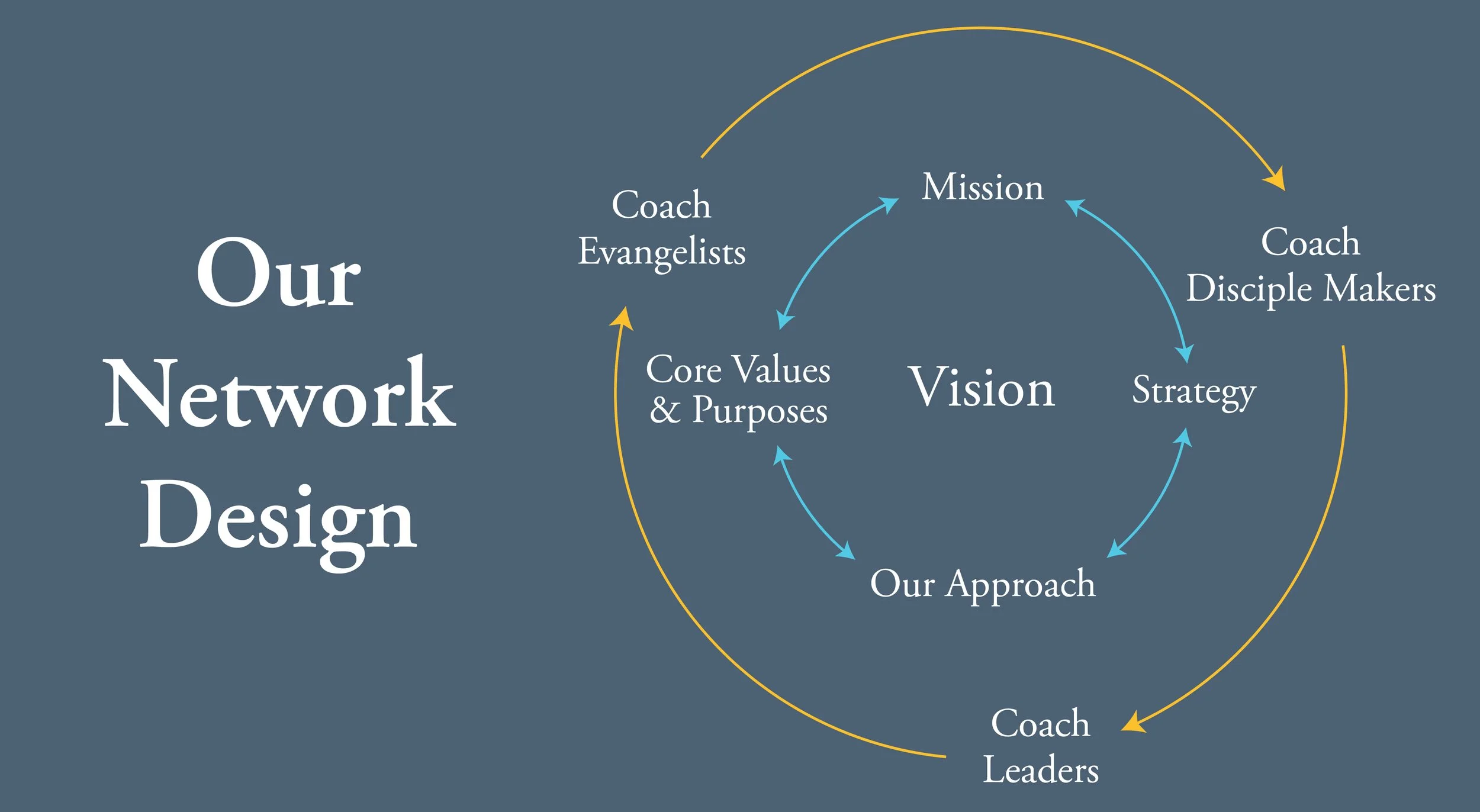
This page brings the whole picture together. At the center is a clear vision of what we hope to see. Around that vision are our mission, core values and purposes, strategy (the Apostolic Cycle), and our approach to making disciples. Surrounding the whole framework is an ongoing pattern of coaching evangelists, disciple makers, and leaders.
Each part answers a different question. Vision describes what we hope to see. Mission defines what Jesus sends us to do. Values and purposes shape what we prioritize. Strategy provides a repeatable pattern for pursuing the mission. Our approach gives ordinary believers a practical pathway for making disciples. Coaching helps people continue growing and helping others do the same.
The sections below provide a brief overview of each part of our network design. Follow the links for a more detailed explanation of our Vision, Mission, Values and Purposes, Strategy, and Our Approach.
1. Vision: What We Long to See
Vision describes what we hope to see as we faithfully carry out our mission. Our mission is to make disciples of all nations. Our vision pictures those disciples gathered, strengthened, and multiplied into churches at every level the New Testament describes—churches in homes, churches across a city, churches throughout a region, and the global body of Christ.
Our vision as a network is simple and expansive:
To start, strengthen, and multiply churches at every level the New Testament describes.
This vision keeps us from thinking too small or too vaguely. It helps us picture households, neighborhoods, cities, and regions filled with gospel-centered churches that live under the lordship of Jesus and participate in his mission together.
For Reflection and Action
How clearly can you picture what it would look like for households, neighborhoods, cities, and regions to be filled with multiplying churches?
Which part of this vision most needs your prayer and attention right now?
2. Mission: What Jesus Sends Us to Do
Mission explains what Jesus has clearly told his church to do. The risen Jesus commissioned his followers to “make disciples of all nations” (Matt. 28:19).
By the power of the Holy Spirit, we are sent to:
Go into all the world, beginning where we are and moving outward.
Proclaim the gospel—the good news of Jesus’s death and resurrection.
Call people to repentance and faith for the forgiveness of sins.
Baptize new believers in the name of the Father, Son, and Holy Spirit.
Teach believers to obey everything Jesus commanded.
Taken together, these describe the mission of the church. This mission is not merely a slogan but a concrete, Spirit-empowered task that shapes how we pray, plan, and live. Our network exists to help ordinary believers and churches carry it out faithfully and reproducibly.
For Reflection and Action
Which part of the Great Commission comes most naturally to you, and which part do you tend to overlook?
What simple step could you take this week to participate more faithfully in Jesus’s mission?
3. Core Values and Purposes: Why We Do What We Do
Core values describe what we cherish. Purposes describe what we are therefore committed to do.
We value Christlike character. Therefore, we are committed to character development.
We value those in need. Therefore, we are committed to service.
We value non-Christians. Therefore, we are committed to evangelism.
We value Christians. Therefore, we are committed to discipleship.
Above all, we value God himself. Therefore, we are committed to worship.
These values and purposes help keep our priorities clear and shape the decisions we make as we pursue our mission and vision.
Read the full Core Values and Purposes page
For Reflection and Action
Which value and purpose needs the most intentional strengthening in your life, home, or church?
What concrete step could you take this week to live out that commitment more faithfully?
4. Strategy: The Apostolic Cycle
Strategy explains how we pursue our mission and vision in a repeatable way. The New Testament shows Jesus continuing his mission through his apostles and the first churches as they repeatedly pursued three central goals:
Reach non-Christians with the gospel.
Strengthen Christians in community.
Develop leaders to start and strengthen churches.
These goals form the Apostolic Cycle. Each goal includes specific activities that can be carried out across different cultures and contexts. As the cycle repeats—reaching non-Christians, strengthening believers, and developing leaders—churches are started, strengthened, and multiplied.
For Reflection and Action
Where in the Apostolic Cycle do you currently see momentum, and where is greater attention needed?
Which non-Christian, Christian, or emerging leader could you intentionally invest in this month?
5. Our Approach to Making Disciples: Love God and Love Others, the Ongoing Commitments, and Five Movements
The Center: Love God and Love Others, and the Ongoing Commitments
At the center of disciple-making is loving God and loving others—the two greatest commands. As we listen to God, depend on him, and obey what he says, our love for him grows and begins to shape how we love others.
Two practices continue throughout the disciple-making process:
Identify our natural networks of relationships.
Pray for ourselves and others.
We do not complete these practices and move on. We continue identifying people and praying as we serve, share the gospel, gather in biblical community, and help others grow as disciples and leaders.
The Pathway: Five Interconnected Movements
From this center flow five interconnected movements—a clear and repeatable pathway for making disciples within our networks:
Serve to meet practical needs.
Seek to find receptive people.
Invite to discover the Christian message.
Gather to grow in biblical community.
Equip to develop new leaders.
Together, these movements help people take steps toward knowing and following Jesus and prepare them to help others do the same.
Read the full Our Approach to Making Disciples page
For Reflection and Action
Which part of the center or ongoing commitments most needs attention in your life right now?
Which of the five movements are you practicing most consistently, and which one needs greater attention?
6. Coaching: The Circle Around the Whole Framework
Coaching provides ongoing relational support for the entire framework. It helps evangelists, disciple makers, and leaders continue growing as they carry out the mission.
Coaching Evangelists: Helping believers deepen their walk with God, recognize opportunities, and clearly share the gospel with non-Christians.
Coaching Disciple Makers: Helping Christians strengthen other believers through Scripture, prayer, obedience, and shared life.
Coaching Leaders: Equipping leaders to shepherd communities, lead gatherings, and start, strengthen, and multiply churches.
Coaching is relational and intentional. Coaches meet regularly with others to listen, ask questions, encourage, pray, and help identify practical next steps. Over time, believers learn both to receive coaching and to help others grow.
For Reflection and Action
Who is currently helping you grow through an intentional coaching relationship, and whom could you begin helping?
Which of the three coaching priorities—evangelists, disciple makers, or leaders—most needs strengthening in your ministry context?
Conclusion
This framework provides a simple picture of how the different parts of our ministry fit together:
Vision at the center: start, strengthen, and multiply churches at every level the New Testament describes.
Mission clearly defined: make disciples of all nations through going, proclaiming the gospel, calling for repentance and faith, baptizing believers, and teaching obedience.
Core values and purposes: Christlike character, service, evangelism, discipleship, and worship.
Strategy through the Apostolic Cycle: reach non-Christians, strengthen Christians, and develop leaders.
Our approach to making disciples: love God and others, identify our natural networks, pray, and move through Serve, Seek, Invite, Gather, and Equip.
Coaching evangelists, disciple makers, and leaders: provide ongoing relational support for growth and multiplication.
As you explore this website, keep this framework in view. Every page, training, and resource fits somewhere within this larger picture. Together, these categories provide a clear framework for pursuing Jesus’s mission and following patterns of ministry seen in his apostles and the first churches.
May God use ordinary believers to make disciples and to start, strengthen, and multiply churches in homes, cities, regions, and nations until Jesus returns.