Individual Coaching and Prayer
A Great Chain of Witnesses—Stretching Back to Jesus
None of us came to Jesus on our own. Someone loved us, prayed for us, and eventually explained how we could know God through Jesus Christ. And behind that person was another person…and another…all the way back through generations to the starting point of the chain: Jesus himself, who called disciples and sent them out to make disciples. Scripture describes this pattern like this: “What you have heard from me in the presence of many witnesses, commit to faithful men who will be able to teach others also” (2 Tim. 2:2).
That is the vision here: disciples who make disciples, and churches that multiply for generations after we are gone—until Jesus returns. The question is not whether we want that. It is whether we will live and lead in ways that make it possible. What actually helps ordinary believers learn, obey, endure, and then help others follow Jesus?
We believe one of the simplest answers is coaching and prayer—steady rhythms that help believers stay close to God, walk faithfully with others, and pass the faith on with clarity and care. Over time, these rhythms strengthen believers so the pattern doesn’t fade or distort, but is carried forward—generation after generation—by ordinary people, by the grace of God.
Coaching and Prayer
Both individual coaching and prayer and group coaching and prayer are essential for healthy disciple-making. Individual coaching creates space for personal conversation, accountability, encouragement, and prayer. Group coaching and prayer shape shared habits of learning, mutual encouragement, and intercession within Christian community. Together, they help ordinary believers grow strong in faith and take part in the multiplication of disciples and churches by the power of the Holy Spirit.
Coach (Mentor) and Coachee (Mentee)
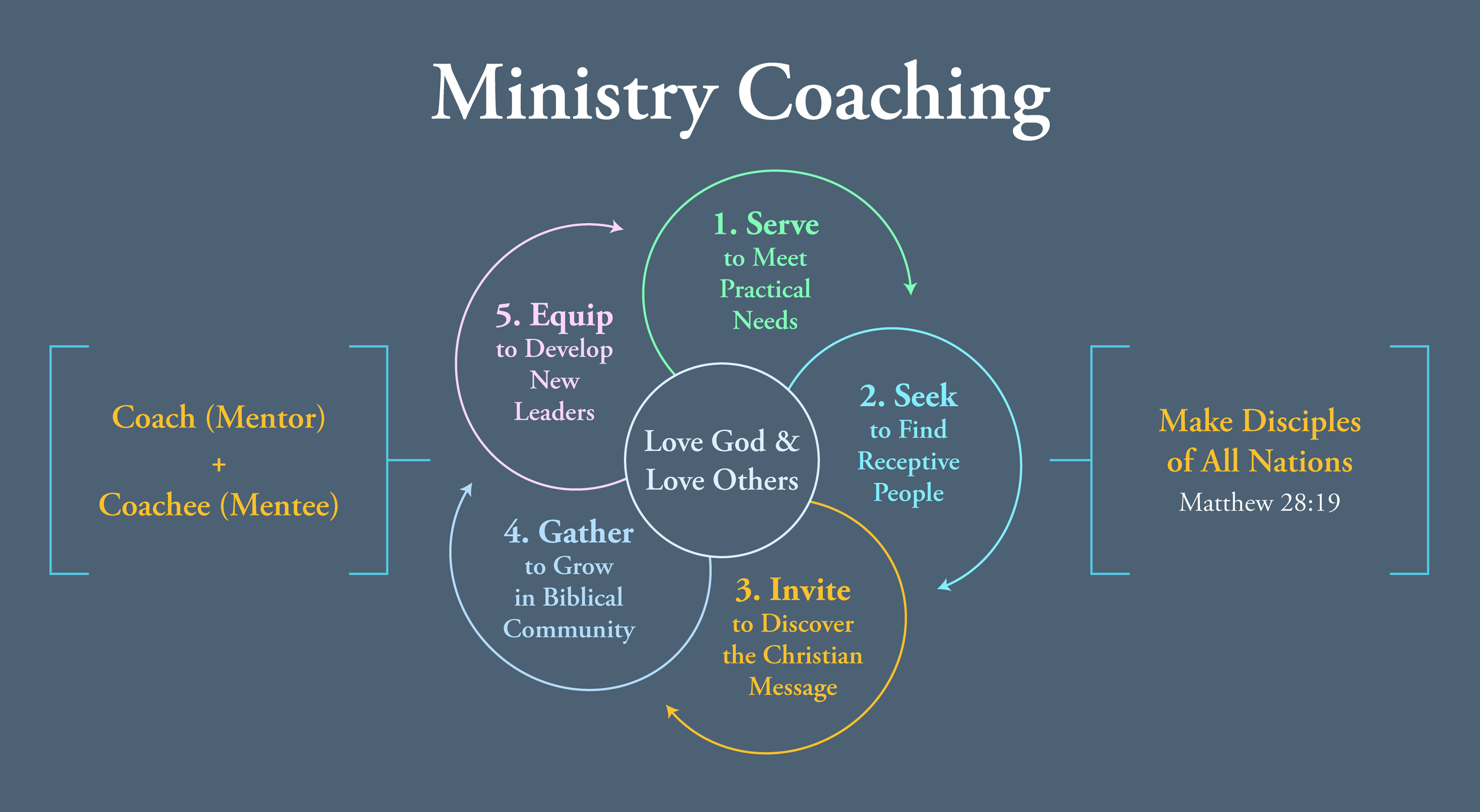
Ministry coaching is a relational and intentional practice in which a coach meets regularly with a coachee to pray, listen, ask questions, and help the coachee grow as a follower of Jesus. Coaching is not counseling, and it is not teaching alone. It is a prayerful conversation that helps believers obey Jesus in everyday life and love others through serving, sharing the gospel, and discipling other believers.
Coaches help coachees pay attention to their relationship with God, their relationships with others, and their calling to make disciples among Christians and non-Christians. Every Christian is encouraged to receive coaching and, over time, to invest in coaching others so disciple-making remains personal, intentional, and reproducible across generations.
The Goal of Ministry Coaching
The goal of ministry coaching is to help believers love God and love others as they obey Jesus and make disciples in the natural settings of life—family, the church, and relationships with non-Christians (Matt. 28:19–20). Coaching creates space to reflect, pray, and take clear next steps toward obedience, maturity, and multiplication.
Our Approach to Individual Coaching
We use the following documents to facilitate coaching relationships:
Session #1: Coaching Introduction and Coachee Snapshot
Session #2: Coaching Framework
Sessions #3–4: The Path to God
Sessions #5 and Following: Coaching Sessions
See below for more detail.
The First Five Sessions
Session 1: Introduce, Map, Pray
Goal: Introduce the concept of coaching, understand the coachee’s world, and establish prayerful trust.
Do this:
Open in prayer.
Read and discuss “Coaching Introduction.”
Complete the “Coachee Snapshot” together.
Ask clarifying questions to understand relationships and key prayer requests.
Close by praying specifically over what surfaced.
Coaching Posture: Listen first. Do not rush to fix or direct.
Session 2: Review the Framework
Goal: Establish shared language for growth and mission.
Do this:
Open in prayer.
Read the “Coaching Framework” page line by line together.
Briefly clarify terms as needed.
Ask which parts feel clear and which feel difficult or unfamiliar.
Avoid assigning action steps in this session.
Coaching Posture: Help the coachee see the whole map before walking the path.
Session 3: Coachee Leads The Path to God (Round 1)
Goal: Shift ownership from coach to coachee.
Do this:
Open in prayer.
Ask the coachee to lead you through “The Path to God”—pages 1 to 5. The coachee’s main goal is to read the document with the coach line by line and to pause to discuss the questions as listed.
Listen carefully without interrupting or correcting unless there is a clear gospel error.
After walking through the document together, give the coachee feedback—what they did well and what could be improved.
Coaching Posture: Treat this as practice for real conversations.
Session 4: Coachee Leads The Path to God (Round 2)
Goal: Build confidence and readiness for real conversations.
Do this:
Open in prayer.
Have the coachee lead through The Path to God—first reviewing pages 1 to 5, and then reading pages 6 to 8 in detail.
Ask who they could share this with in real life.
After walking through the document together, give the coachee feedback.
Coaching Posture: Encourage repetition and courage rather than perfection.
Session 5 and Beyond: Practice the Ongoing Rhythm
Goal: Introduce and implement the regular coaching structure.
Do this:
Ask the coachee to complete the “Coaching Sessions” sheet beforehand.
Read aloud the “Note to Coach and Coachee” at the top of the “Coaching Sessions” page.
Walk through the sheet together.
Emphasize that not every section needs to be filled out every time.
Model choosing one main focus rather than covering everything.
Coaching Posture: Teach focus and realism, but do not overwhelm.