The Path to God

Click here to print a copy of this lesson for yourself or multiple copies so you can talk through the lesson with others.
Imagine you are standing before God, the Creator of all people and things, who reveals himself to us in the Bible. Then consider these questions:
On a scale of 0 to 100%, if you died today, how certain are you that you would spend eternity with God in heaven?
If God were to ask you, “Why should I allow you to spend eternity with me?” what would you say?*
How does someone become a Christian?
Pause to answer these questions. Also consider asking these questions of others.
How can we categorize different answers to the questions from the previous page? See the chart below and “Additional Information” at the bottom of this page.
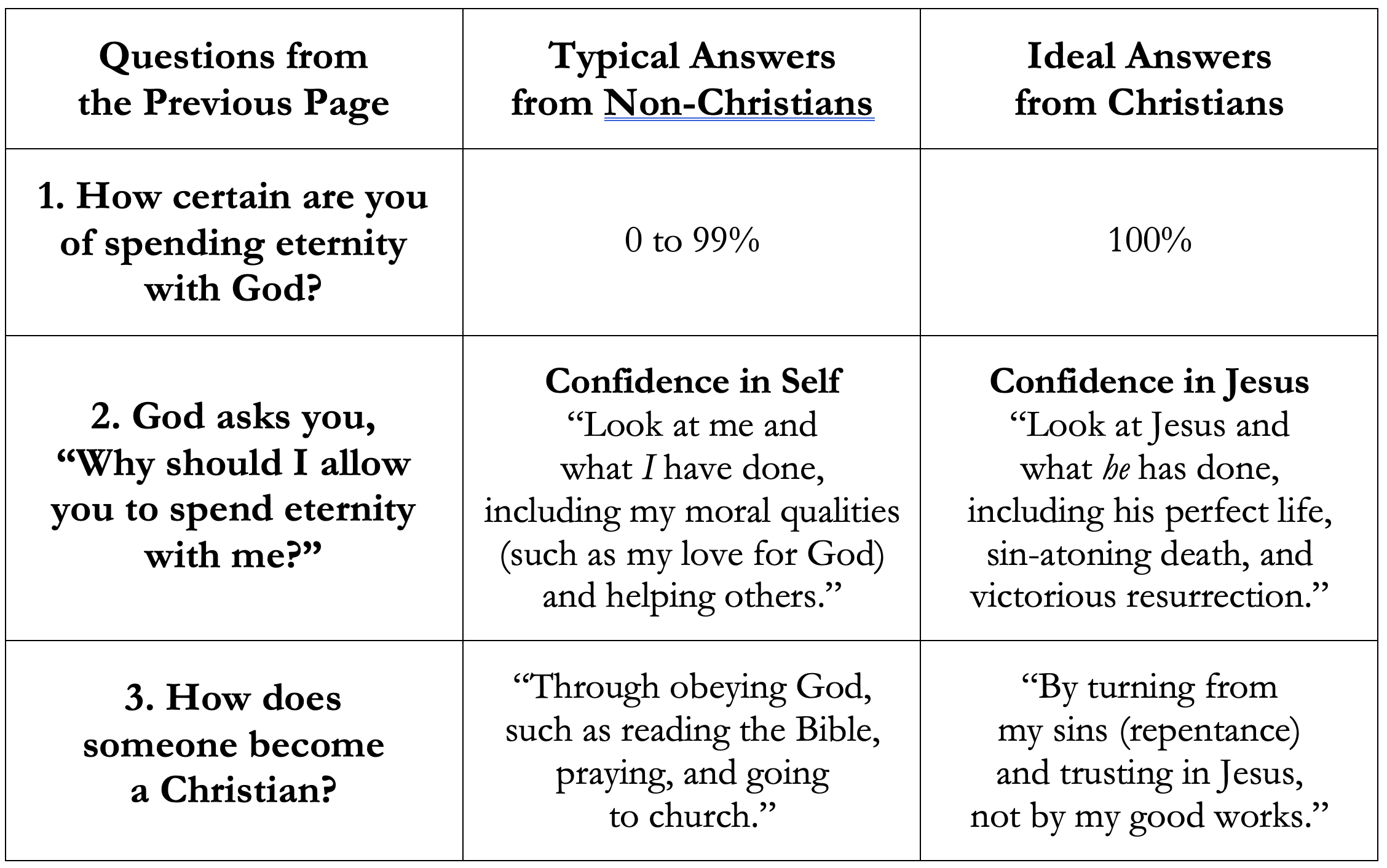
If you lack assurance that you are in a right relationship with God and will live with him forever, this lesson will clarify how you can begin a relationship with him. If you have assurance of your salvation, this lesson will clarify the proper reasons for assurance of salvation and how you can share these truths with others. Either way, God calls us to understand and embrace the following truths:
1. God is the Creator, Lord, Provider, Lawgiver, and Judge of all people.
“The God who made the world and everything in it—he is Lord of heaven and earth—does not live in shrines made by hands. Neither is he served by human hands, as though he needed anything, since he himself gives everyone life and breath and all things.” (Acts 17:24–25)
As Creator, God made all people and things, and therefore he alone is worthy of our highest love, worship, and commitment (Acts 14:15; 17:24; Rom. 1:19–23). As Lord, he sovereignly rules over his creation, governing all things to fulfill his purposes (Ps. 103:19; Acts 17:24). As Provider, he showers us with good gifts—life, food, family, and friends (Acts 14:17; 17:25; James 1:17). As Lawgiver, he has revealed his commands in Scripture, reflecting his holy character and setting moral standards for all people (Acts 17:30; 2 Tim. 3:16–17). As Judge, he will hold everyone accountable for how they have lived in light of his revealed will (Acts 17:31; Rom. 2:16). Since God has revealed himself so clearly in Scripture and in creation, the ultimate tragedy is that humanity has rejected him and chosen sin instead.
2. We sin against God. Therefore, we deserve his eternal judgment.
“For all have sinned and fall short of the glory of God.” (Rom. 3:23)
“For the wages of sin is death.” (Rom. 6:23)
All of us have sinned against God and fall short of his glory: we fail to meet God’s standard of perfection (Rom. 3:23). Put simply, sin is disobeying God’s commandments in our thoughts, words, and actions (Rom. 3:9–20; 1 John 3:4). Sin is also an act of rebellion against God and his authority (Isa. 1:2; Jer. 3:13). But the heart or essence of sin is that we value other people and things more than God himself, which is idolatry (Rom. 1:25; Col. 3:5).
Whether our sins take the form of vanity, greed, or lying, every sin makes us deserving of God’s eternal judgment (Rom. 1:18; Gal. 5:19–21; Col. 3:5–6). The “wages” we earn for our sin is death—both God’s present judgment in this life and his final judgment in the next (John 3:18; Rom. 6:23; Eph. 2:1). Even now, God’s wrath is revealed as he gives people over to the power of their sinful desires, letting those desires rule them and lead them into deeper and deeper sin (Rom. 1:24–28). Put simply, because God is holy and just, he will give us exactly what we deserve—his judgment—unless we seek and receive his forgiveness through Jesus Christ (Rom. 2:5; Heb. 9:27).
3. God sent Jesus into the world to die for our sins as an atoning sacrifice, raised him from the dead, exalted him to his right hand as Lord over all, and will send him again to judge humanity.
“For I passed on to you as most important what I also received: that Christ died for our sins according to the Scriptures, that he was buried, that he was raised on the third day according to the Scriptures.” (1 Cor. 15:3–4)
“[God] exercised this power in Christ by raising him from the dead and seating him at his right hand in the heavens—far above every ruler and authority, power and dominion, and every title given, not only in this age but also in the one to come.” (Eph. 1:20–21)
God fulfilled his Old Testament promises through Jesus’s coming to earth, his death, resurrection, and exaltation to God’s right hand to rule (Luke 24:44–46; Acts 2:22–36). Jesus lived a sinless life, qualifying him to bear the penalty for our sins, and God worked miracles through him to confirm his divine identity (Acts 2:22; Heb. 4:15). Jesus died on the cross as an atoning sacrifice—bearing sin’s penalty and satisfying God’s justice (Rom. 3:25–26; 1 Cor. 15:3; 1 John 2:2). After three days, God raised him from the dead, declaring him innocent and victorious over death (Rom. 4:25; 1 Cor. 15:4). God exalted him to his right hand as Lord, Christ (the Anointed One), and Savior (Acts 2:24, 36; Eph. 1:20–23). He will send Jesus again to judge the living and the dead (Acts 3:20–21; Rev. 19:11–16).
In answer to question #2 at the top of the page, Jesus and his saving work (his perfect life, sin-atoning death, and victorious resurrection) are the only bridge to God the Father, not our good works. Jesus said, “I am the way, the truth, and the life. No one comes to the Father except through me” (John 14:6).
4. We must turn from our sins (repent) and trust in Jesus to become a Christian—to avoid eternal judgment from God and to gain eternal life with God.
“Therefore repent and turn back, so that your sins may be wiped out.” (Acts 3:19)
“For you are saved by grace through faith, and this is not from yourselves; it is God’s gift—not from works, so that no one can boast.” (Eph. 2:8–9)
God offers forgiveness freely to all, but this free gift must be received to be applied to our lives (John 1:12; Rom. 6:23). How do we become a Christian and receive the gift of eternal life?
First, we turn from our sins (repent), including sins such as valuing people or things more than God (Acts 3:19; Rom. 1:25; 2 Cor. 7:9–10; 1 Thess. 1:9). While sorrow over sin is appropriate, remorse or regret alone is not enough. We must decisively turn from our sins and express to God that we no longer want to live in rebellion against him. We turn from valuing anyone or anything above God—which is idolatry—whether that involves family, friends, entertainment, money, possessions, or career. Sadly, some of God’s greatest gifts often become our greatest idols. We also turn from sins such as self-centeredness, pride, sexual immorality (e.g., pornography or sex outside of marriage), drunkenness, vanity, greed, and lying. Our decision to turn from sin declares that God alone is worthy of our highest love, worship, and devotion.
At various points in our lives, most of us have struggled with persistent patterns of sin that lasted for years or even decades. With that in mind, which specific sins is God calling you to turn away from?
Second, we trust in Jesus rather than trusting in ourselves (John 3:16; Rom. 3:22, 26; Gal. 2:16; Eph. 2:8–9). Simply acknowledging that Jesus died and rose again is not enough—for even demons believe those truths. Saving faith means personally trusting in Jesus himself and in what he accomplished through his death and resurrection. At the same time, we turn from relying on our perceived moral goodness or good works, recognizing that salvation can never be earned. We are saved by grace—God’s unmerited favor—through faith alone.
Many people around the world believe they can earn their eternal salvation. Do you believe you can earn your salvation before God? Why or why not?
Turning from our sins and trusting in Jesus (taken together) are not good works that earn our salvation before God. Instead, they are the way we receive God’s grace (Acts 20:21).
In answer to question #3 at the top of the page, repentance and trust in Jesus are how we cross the bridge to God the Father—a bridge created by Jesus alone.
Responding to This Summary of the Christian Faith
Now that you have read and reflected on this summary of the core teachings of the Christian faith, which one of the following categories describes you?
1. You are a Christian, for you have already turned from your sins and trusted in Jesus. If so, hopefully this summary strengthened your faith in Jesus, clarified how you can faithfully share these truths with others, and gave you additional reasons to rejoice in your salvation (Hab. 3:18; Philem. 6; 1 John 5:13).
If you are a Christian, pause here to discuss these questions:
Where and when did you make a conscious decision to turn away from your sins (rather than merely feeling regret and sorrow) and trust in Jesus?
We’ll explore baptism in more detail below. For now, since many people are “baptized” as infants or young adults before becoming Christians (which is not the biblical pattern), were you baptized after turning from your sins and trusting in Jesus? Explain.
With whom might God want you to share this document?
2. You are not a Christian, and you are not ready to turn from your sins and trust in Jesus. If so, know that the offer of eternal life with God still stands, but no one is guaranteed life tomorrow (1 Tim. 2:3–4; James 4:13–16; 2 Pet. 3:9).
3. You are not a Christian, but you are ready to turn from your sins and trust in Jesus—so you can enter a right relationship with God and live with him forever. If so, today is the day of your salvation (Rom. 10:9; 2 Cor. 6:2)! Consider praying a prayer like this:
“Dear God, I confess you as my Creator, Lord, and Provider. I have sinned against you in my thoughts, words, and deeds. I therefore deserve nothing but judgment from you. Jesus and his life, death, and resurrection are my only hope for entering a relationship with you. I accept the gift of eternal life by turning away from my sins and trusting in Jesus. Please forgive me of my sins and give me the gift of your Holy Spirit to lead me forever. Jesus is the Lord of my life from now on. I pray this in Jesus’s name. Amen.”
If you prayed to become a Christian, welcome to the family of God! This is a time for great joy! Now, consider sharing your decision with others—especially those who are not yet Christians—so they too can experience a relationship with God and live with him forever. Who might God want you to tell?
What is true of all Christians?
1. We have received the gift of the Holy Spirit to guide and empower us.
“Repent and be baptized, each of you, in the name of Jesus Christ for the forgiveness of your sins, and you will receive the gift of the Holy Spirit.” (Acts 2:38)
“I say, then, walk by the Spirit and you will certainly not carry out the desire of the flesh [our sinful nature].” (Gal. 5:16)
At the moment we turn from our sins and trust in Jesus, God gives us the Holy Spirit to guide and empower us (Acts 2:38; Rom. 8:14–17). God also forgives our sins, adopts us into his family, and sets us apart for himself and his purposes (John 1:12; 1 Cor. 6:11; Eph. 1:7). Each of these blessings is received instantly. Yet growing into the likeness of Jesus takes a lifetime, so the Spirit helps us resist sin and practice godliness until we are with Christ, when he will purify us completely (Gal. 5:16; 1 John 3:2–3). Until then, we confess our sins quickly and turn back to God in faith (1 John 1:9; 2:1–2).
2. With the strength God provides, we seek to obey him in every area of our lives, including getting baptized and actively participating in a local church.
“Go, therefore, and make disciples of all nations, baptizing them in the name of
the Father and of the Son and of the Holy Spirit, teaching them to observe everything
I have commanded you. And remember, I am with you always, to the end of the age.” (Matt 28:19–20)“And let us consider how to stir up one another to love and good works, not neglecting to gather together, as some are in the habit of doing, but encouraging each other, and all the more as you see the day [of the Lord’s return] approaching.” (Heb. 10:24–25)
Baptism is an act of obedience that testifies to our new faith in Christ. It symbolizes our union with him as we are immersed in water in the name of the Father, the Son, and the Holy Spirit (Matt. 28:19; Acts 2:38, 41). All Christians have been spiritually “baptized” into Christ’s death and raised with him to new life (Rom. 6:3–4; Eph. 2:4–7). Water baptism—going down into the water and coming up again—is a visible sign of these deeper realities.
Some people were “baptized” in water before personally turning from sin and trusting in Jesus—often as infants or young teenagers. In such cases, baptism preceded genuine conversion and therefore does not match the pattern taught in Scripture. God calls us to be baptized after we turn from our sins and trust in Jesus. If you were baptized before becoming a Christian through repentance and faith, consider being baptized in water as a believer for the first time.
Throughout our lives, God empowers us to grow in faith and obedience, learning to follow all that Jesus commanded (Matt. 28:20). As part of that obedience, we join in Jesus’s mission to “make disciples of all nations.” We grow in faith through personal devotion—reading Scripture and praying—and through active participation in a community of believers. Together we worship, celebrate the Lord’s Supper, study the Bible, pray, serve others, and sing to God with thankful hearts (Acts 2:42–47; 1 Cor. 11:17–34; Col. 3:16; Titus 2; Heb. 10:24–25; 1 Pet. 4:10–11).
For Reflection and Discussion
1. Prior to reading this summary of how to begin a relationship with God, how did you answer the questions at the top of the page?
2. Now that you have read the summary, would you answer the three questions in the same way or differently? Explain.
3. Do you think Jesus is the only way to God the Father? Why or why not?
4. What does it mean to turn from our sins (as an act of both the mind and the will)? What does it mean to trust in Jesus? Viewed together, have you come to God in this way? If not, what obstacles stand in the way?
5. What is Christian baptism? If you are a Christian, were you baptized after you both (1) turned from your sins and (2) trusted in Jesus (as opposed to trusting in your good works) for salvation? Explain.
6. If you are a Christian, what is your plan for growing in your faith (both privately and with other Christians)?
Additional Information: Clarifying Your Own (and Others’) Responses to the Three Diagnostic Questions
At the beginning of this lesson, you were asked these three questions:
1. On a scale of 0 to 100%, if you died today, how certain are you that you would spend eternity with God in heaven?
2. If God were to ask you, “Why should I allow you to spend eternity with me?” what would you say?
3. How does someone become a Christian?
From God’s perspective, as revealed in the Bible, you should be concerned if you answered the three questions in one or more of the following ways:
Your answer to question #1 fell between 0 and 99%, particularly if you are merely thinking about your own moral shortcomings and/or your perceived moral goodness before God. The Bible is clear: We have all sinned against God (in our thoughts, words, and actions) and are falling short of his will for our lives (Rom. 1:25; 3:23). We cannot earn salvation based on our good works (Eph. 2:8–9; Titus 3:5). It is therefore troubling when people say they are “70% sure” or “85% sure” they will spend eternity with God based on their behavior. In their words, they “still have room for improvement” in their behavior before they can earn (or merit) eternal salvation—which no sinful person can do. It is also troubling when people say they are “100% sure” but their answers to question #2 reveal that their ultimate confidence before God is in their good works, not in Jesus Christ. For all who trust in their good works to obtain salvation, they should have no such confidence (Rom. 3:20; Gal. 3:10).
Your answer to question #2 outlined your spiritual résumé (your list of moral qualifications) that you would present to God, such as your church attendance, Bible reading, or care for the poor. This also reveals a works-based view of salvation—a view that ignores (or attempts to add to) Jesus Christ and his saving work. Only Jesus and his death and resurrection serve as the basis by which anyone can be reconciled to God and live with him forever (Rom. 3:21–26; 1 Cor. 15:1–4; 2 Cor. 5:21; 1 John 2:1–2).
Your answer to question #3 failed to include both (1) turning from your sins (repentance) and (2) trust in Jesus (as opposed to trusting in yourself to gain access to God). Repentance and trust in Jesus Christ—taken together—is the means by which we enter a relationship with God (Mark 1:15; Acts 20:21; Gal. 2:16). It is the way we accept the gift of eternal life, the way we become Christians. Then, by God’s grace, we receive the gift of the Holy Spirit, who helps us to grow into the likeness of Jesus (Acts 2:38; Rom. 8:29; Gal. 5:16–26).
* Questions one and two at the top of this page are adapted from D. James Kennedy’s diagnostic questions found in his book and training program called Evangelism Explosion.